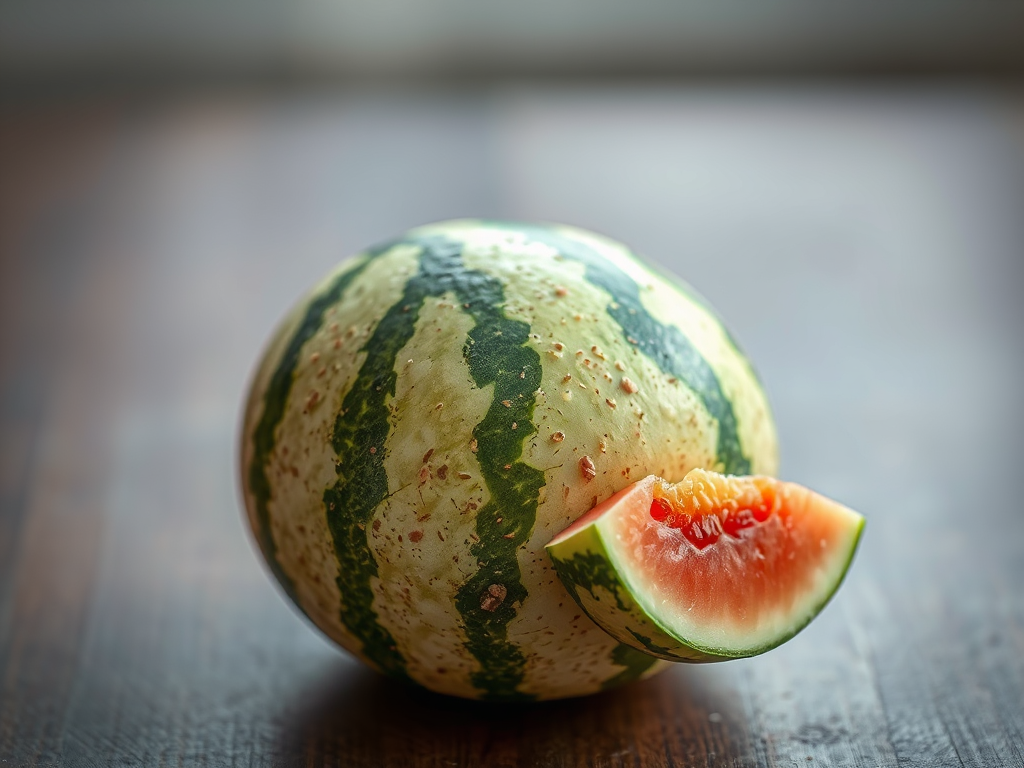
Titelbild: Wassermelonenrindschale – das neue Prebiotikum?
Ernährung 25.08.2026
Méndez DA, Enríquez-Belenguer A, Calvo-Lerma J et al.

Wassermelonenrindschale – das neue Prebiotikum?

EN: Watermelon rind pectin structure influences digestibility and impacts on gut microbiota: a comparative in vitro study.

KI-Zusammenfassung (Deutsch)

Neue Studie erkennt positive Effekte von Wassermelonenrindschale auf den Darmflora. Welche Art von Pectin ist am effektivsten?

Einleitung

Ernährung ist ein zentrales Thema, das unser Wohlbefinden direkt beeinflusst. Eine neue Studie hat Wassermelonenrindschale ins Visier genommen, um ihre Auswirkungen auf den menschlichen Darmflora zu untersuchen. Dabei haben Forscher zwei verschiedene Pectin-Sorten identifiziert, die in unterschiedlichem Maße wirken können.

Studienergebnisse & Methodik

Pectin ist ein komplexes Molekül, das in Früchten wie Zitrusfrüchten und Wassermelonen vorkommt und eine wichtige Quelle von Schleimfasern ist. In dieser Studie wurden zwei verschiedene Wassermelonenrindschale-Pectine analysiert: ein weniger gebogene (LB) und ein mehr gebogene (HB). Diese Pectine wurden in vitro im menschlichen Darm und im Koloniefermenter untersucht. Die Ergebnisse deuten darauf hin, dass das natürliche, mehr gebogene Pectin im Wassermelonenschale besonders wirksam ist.

Kritische Einordnung

Die Untersuchung war sowohl ein in vitro als auch ein in vivo Versuch, was ihre Relevanz erhöht. Die humanorientierte Methode ermöglicht es, die Effekte der Pectine auf den menschlichen Darmflora direkt zu analysieren. Allerdings haben die Pectine unterschiedliche chemische Strukturen, die ihre Wirkung beeinflussen. Die natiürliche, mehr gebogene Pectinart (HB) hat signifikant mehr Short-Chain-Fettverbundsauren (SCFA) produziert, insbesondere Propionat, obwohl sie eine höhere Molekülmasse hat.

Praxis-Fazit

  • Ernährung: Fügen Sie Wassermelonenrindschale in Ihre Ernährung ein, um eine positive Auswirkung auf Ihren Darmflora zu haben.
  • Darmgesundheit: Nutzen Sie das natürliche, mehr gebogene Pectin, um einen hohen SCFA-Anteil zu erzielen.
  • Wasserfluss: Trinken Sie genügend Wasser, um die Pectine gut zu verdauen.

Original-Abstract (Englisch)

Pectin is one of the most complex families of carbohydrate structures and one of the main sources of soluble fibre, with positive health effects when included in the diet. Additionally, food and agricultural waste are vast potential sources of further pectin ingredients. In this study, two watermelon rind pectin samples with less branched (LB) or branched (HB) structures were compared with standard citrus pectin (CP) and galactan (PG). The distinct pectin samples with well-defined structural features were subjected to in vitro human gastrointestinal digestion followed by a colonic static fermentation in order to study the impact of digestion on pectin composition, molecular weight, and also impact on gut microbiota composition and metabolic activity through 16S rRNA amplicon sequencing and short chain fatty acid (SCFA) profile, respectively. In the case of the lower molecular weight LB, no significant increase in SCFA production was observed despite maintaining higher alpha diversity of the gut microbiota composition compared to control. On the contrary, the natively highly branched pectin from watermelon (HB) displayed highest SCFA production, especially propionic acid (12-17 mM), compared to PG or CP references, despite a higher molecular weight (∼400kDa) hampering accessibility and reducing overall bacterial survival. The results put forward the potential of watermelon pectin sources as novel alternative prebiotic ingredients.

Journal: Food research international (Ottawa, Ont.)
PubMed ID: 42637379